Trademark
August 18, 2026
By Emily Poler
Several weeks ago I was writing about a hiking drag queen influencer. Today, it’s the Mormon church. How did I get here? I have no idea, but wherever you go in the world of trademark infringement, there you are. In fact, the drag queen and the Mormon cases even have something in common as they both involve a large entity suing a much smaller one for infringement.
In the case of the latter (pun intended), the Church of Jesus Christ of Latter-Day Saints (the “LDS Church”) recently brought a case against Dr. John Dehlin, his podcast and website that have operated under the name “Mormon Stories” since 2005, and his Open Stories Foundation, the nonprofit that funds his work. According to the website’s homepage, “Mormon Stories” is a “community where your doubts and questions are valued and understood.” That community includes criticism of the LDS Church, along with fervent support for LGBTQ+ Mormons.
The Church of Jesus Christ of Latter-Day Saints is, of course, the world’s largest Mormon denomination, and its lawyers claim (among other things) that the name “Mormon Stories” and a logo used by the podcast infringe on the church’s trademarks, including its trademark in the word “Mormon.” The filing asserts that this has and will continue to cause people to believe that the podcast and website are affiliated with the church and/or endorsed by it, or cause consumers to be confused. On the confusion point, the complaint presents a number of comments from social media where people listened to the podcast believing it was affiliated with the church, but then realized that the podcast was, in fact, critical of the LDS and not in line with official doctrine.
The Defendants counter by accusing the Church of “attempting to use intellectual property law to restrict lawful commentary about Mormonism” and have moved to dismiss the trademark infringement claim on grounds that it is barred by the First Amendment. Here, they point to Rogers v. Grimaldi, which held that in the context of the name of creative work, trademark concerns have to yield to the First Amendment unless the Defendant’s use of a mark is completely irrelevant to the underlying work and explicitly misleads consumers about the source or content of the work. In this case, the word “Mormon” is required to describe what the podcast and website are about. Defendants also note that they are not misleading consumers, as they “include written disclaimers on their websites, YouTube channel, and other podcast distribution platforms.”
At the heart of the Defendants’ defense, however, is their focus on the fact that “Mormon” does more than refer to the LDS Church. As the ACLU puts it in the amicus brief it submitted in support of the Defendants, the “word ‘Mormon’ is not a source identifier. It is a term that describes an entire ethnoreligious culture, tradition, and people, many of whom are not members of the Church of Jesus Christ of Latter-Day Saints.” In other words, all LDS are Mormons, but not all Mormons are LDS, and in its brief the ACLU describes myriad religious communities that use the name “Mormon.” In fact, the Defendants are seeking to cancel the church’s trademark in the word “Mormon.” Oh, snap.
And thus, the LDS Church’s lawsuit seems like it could have opened up a can of worms they’d rather have remained closed. Moreover, some of those other Mormon denominations have had their own well-documented problems with the LDS (and, for that matter, the law, see Warren Jeffs). Litigation here is likely to include an exploration of those various groups, their history, and how they use the word that the LDS Church claims it owns. That could make it difficult for the LDS to continue to claim trademark rights to that word and end up with people talking about things that the LDS Church would probably rather not have discussed. They could end up the big losers here.
Also, talking about the legal basics of trademark infringement, why has the Church waited so long? They’ve allowed the Mormon Stories podcast and website to operate for more than 20 years, and as we know, the more lax you are in defending your trademark, the harder it is to protect. (This is why Patagonia quickly brought its lawsuit against Pattie Gonia rather than let her continue to use her versions of the mark.) In fact, Defendants claim the Church has “publicly abandoned” its trademark. For a massive organization with an army of attorneys, that seems pretty irresponsible, and it may be difficult to explain away to a judge.
June 9, 2026
By Emily Poler
It’s June, so happy Pride! I certainly hope this month’s events will be full of fun for everyone who honors and rejoices in the celebrations, although I worry about one drag superstar who is currently embroiled in a trademark infringement case. It’s blowing up on social media at the moment and, unfortunately, I don’t think it is going to end well for her.
Pattie Gonia is an activist, performer and hiking enthusiast who uses her Instagram and TikTok to promote LGBTQ+ and environmental causes to almost three million followers. She’s also the defendant in a lawsuit brought by — you guessed it — outdoor apparel brand Patagonia, which accuses her of appropriating its trademark.
The “Pattie Gonia” persona was created by Wyn Wiley in 2018, who says the name was inspired by the region in South America, and not a parody of the clothing company. During her initial rise to fame she accomplished feats like hiking the California coast in high heels, with her various adventures raising millions for environmental nonprofits. Patagonia was apparently aware of and cool with her name in connection with such advocacy. That changed in early 2022, when the company learned Pattie Gonia was planning fundraising partnerships with Hydro Flask and The North Face — two of Patagonia’s competitors. The parties met and, according to Patagonia, came up with an agreement that, from Patagonia’s point of view, provided that Pattie Gonia would not use Patagonia’s logos, fonts, or designs that mimic Patagonia’s in her visual materials or use “Pattie Gonia” in any form on any product. These understandings were subsequently memorialized in emails. According to Patagonia, the idea here was to both protect Patagonia’s brand and “leave some space for Pattie Gonia’s fundraising in support of environmental causes.”
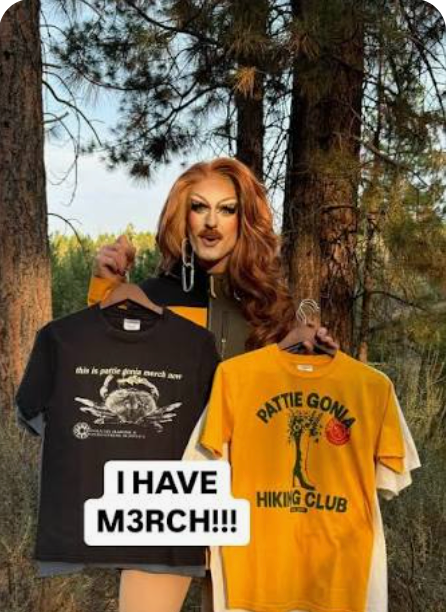
Fast forward a few years and we have this:
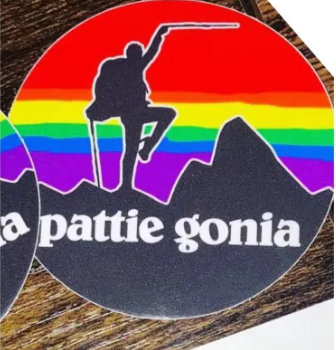
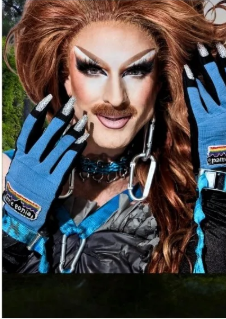
And, perhaps more egregiously (look at the logo on the gloves):
What’s more, in September 2025 Pattie Gonia sought to register a trademark for “Pattie Gonia” for drag shows and t-shirts, as well as promotion of goods and services on social media.
Unsurprisingly, Patagonia sued, asserting claims for, among other things, trademark infringement, unfair competition, and trademark dilution. The company has made clear in its statements that it recognizes both parties share the same devotion to environmentalism, going on to say, “we wish this lawsuit had not been necessary, and we want to acknowledge any hurt it has caused, especially in the LGBTQ+ community.” The company is only seeking to recover $1 from Pattie Gonia, instead asking her to “withdraw all trademark applications,” “stop using our logos” and “stop selling and promoting apparel and other products as Pattie Gonia.”
Pattie Gonia, through her lawyers, answered the complaint by denying the allegations and asking for a trial. The dispute has flown pretty much under the radar since the suit was filed in January, but last month she took her case to social media, insisting “no deal” and inspiring her upset followers to demand Patagonia drop the suit. She also responded through an open letter to Patagonia’s CEO, Board of Directors and others, concluding with a plea to “make peace and get back to our common love of the planet including our namesake region in South America named Patagonia.” She also denied ever using the Patagonia brand, logo or font on her merch, claiming “the lawsuit cherry-picks a few examples of playful parody and fan art and tries to spin those into some kind of vast use of their logo.”
Pattie Gonia says she’s willing to drop her trademark registration filing and “never parody their logo ever again,” but she’s standing firm on Patagonia’s third demand — that she stop selling Pattie Gonia branded product — saying it would eliminate “the partnership work with other brands that I’ve done for years to pay for education, advocacy and activism that me and my team do. If I can’t do partnerships as Pattie Gonia, it breaks the whole ecosystem of advocacy and community engagement.”
As much as my heart is very much with Pattie Gonia, I have a couple of observations about this lawsuit, some of which may give her and her followers some hope, but ultimately point to a bad end for the performer:
- For those in the back (and everyone else), if you have an agreement, get it in writing. The emails Patagonia is relying on may be enough here, but it would definitely have been better to create a written document. In fact, while Patagonia repeatedly says it had an agreement with Pattie Gonia delineating what each of them could and could not do, Patagonia itself doesn’t seem to think that there’s anything enforceable here because, notably, it doesn’t bring a breach of contract claim;
- There’s a decent argument that Pattie Gonia’s merch without anything resembling Patagonia’s very recognizable logo isn’t infringing;
- WIth that said, an alternative spelling that is pronounced the same or similarly to an existing mark can be the basis for trademark infringement;
- Also, to the extent that consumers think that Pattie Gonia is somehow affiliated with or endorsed by Patagonia, that’s a basis for liability;
- The fact that both Patagonia and Pattie Gonia are based on an actual place doesn’t change the analysis because it’s pretty safe to say that many consumers associate the word with the company;
- To the extent there’s a defense of parody to claims of trademark infringement, it could theoretically apply to drag shows, but it’s not going to apply to Pattie Gonia’s sale of t-shirts and other merch; and
- Regardless of whether Pattie Gonia is promoting causes Patagonia supports, Patagonia has to enforce its trademark rights or else it risks losing them.
At the heart of Patagonia’s suit is, of course, the question of whether “Pattie Gonia” is likely to cause confusion or dilute Patagonia’s brand by causing consumers to think Patagonia has sponsored or approved any of Pattie Gonia’s products. And looking at the pictures above, it seems pretty likely.
February 3, 2026
By Emily Poler
Is one of these things a little too much like the other?
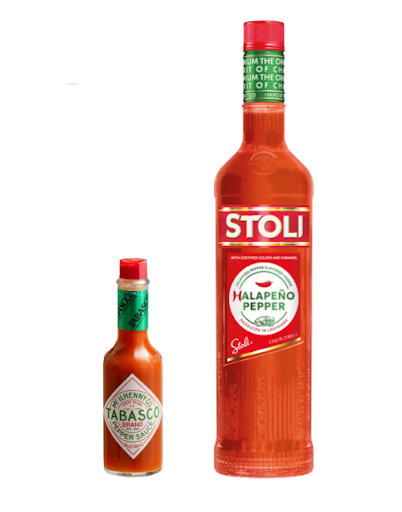
I’d like to say, you decide. But nope. The lawyers are involved.
Last week, McIlhenny Co., the company behind the ubiquitous Tabasco hot sauce, filed a lawsuit in Texas against Stoli Group (USA), LLC, asserting that Stoli’s spicy vodka, which hit shelves in December, infringes on Tabasco’s trade dress and that Stoli is engaged in unfair competition.
So what’s likely to happen? What are the merits of the parties’ respective positions? What the heck is trade dress, and is it what I wear to a formal affair? (OK, maybe not that.)
Before we get to these burning questions, let’s ask another: Why did Stoli pull this obvious copycat move? Well, there’s history. In 2024, Stoli and McIlhenny had initial discussions “about the potential development of co-branded pepper sauce vodka” that would be marketed under both the Tabasco and Stoli trademarks. However, McIlhenny “ultimately decided to go in a different direction and terminated discussions.” That different direction turned out to be a partnership with one of Stoli’s most famous competitors: Absolut Tabasco, which just launched. Zing!
Undaunted by McIlhenny’s rejection, Stoli continued development on its own, and in December, debuted its own peppery vodka product in the bottle pictured above that bears an unsubtle similarity to the Tabasco container — a design that, according to McIlhenny, is quite similar to what Stoli proposed to them for their potential co-branded product:
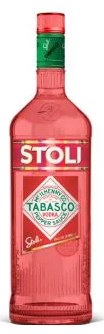
Trade dress is the official phrase that covers the shape and design of a product’s packaging. Think of the clear glass bottle with ridges and a red cap for Coca-Cola, or the squareish shape of a bottle of Maker’s Mark with its red wax seal on top. Here, it’s quite obvious that McIlhenny has trade dress rights, including, at a minimum, the green and red color scheme of Tabasco’s cap and labels. In fact, as it points out in its complaint, the company has at least four trademark registrations for Tabasco’s trade dress.
Case closed, right? Ah, but there’s a hitch. McIlhenny’s registrations, in the language of the United States Patent and Trademark Office are for “[c]ondiment-namely, pepper sauce,” “clothing, namely [t]-shirts and ties,” and (somewhat inexplicably), “pre-recorded audio and video compact disks featuring music, recipes and antique labels for educational, amusement, cultural and artistic purposes; computer mouse pads; neon signs and decorative magnets.”
Based on what’s in the complaint, McIlhenny does NOT have a registration covering beverages, alcoholic or otherwise. (As much as it would be fun on a slow day, I have not done a deep dive into McIlhenny’s full trademark portfolio, although I’m quite sure they don’t have any rights over Mexico’s Tabasco state.) The lack of beverage registration could make it hard for McIlhenny to pursue its claim for trade dress infringement. That doesn’t mean that they’re without rights here.
Clearly, regardless of whether the packaging is for “computer mouse pads; neon signs and decorative magnets” or for alcoholic beverages, the packaging for Tabasco is quite recognizable. So even if McIlhenny’s claim for trade dress infringement doesn’t go anywhere, its claim of unfair competition may fare better.
What’s likely to happen here? McIlhenny is requesting a preliminary injunction preventing Stoli from using the bottle until the lawsuit heads to trial. Ultimately, though, I predict the case will settle. For one thing, in 2024 Stoli Group (USA) filed for bankruptcy, and last month filed to convert proceedings to Chapter 7 liquidation (before one condemns Stoli as a purely evil villain here, keep in mind a lot of the company’s problems stem from its ongoing conflict with the Russian government over, among other things, Stoli’s public condemnation of the invasion of Ukraine). While I have no clue as to Stoli’s financial situation, as a general matter, being in bankruptcy means that the debtor owes more than it has coming in the door. Very rarely do plaintiffs want to spend the money associated with litigating to find out that there’s nothing left to satisfy an eventual judgment. McIlhenny’s goal then, is to get Stoli to stop copying their sauce, and not to try and squeeze some money out of them.
Stay tuned, updates to come as this one heats up.
December 9, 2025
By Emily Poler
I’m not much of a sports fan (although I confess to curiosity about the new Professional Women’s Hockey League), so it’s hardly surprising I never pay attention to ads tied into the Super Bowl. Sure, I’ll go to a party on the day to nibble nachos, chat with similarly blasé guests and watch the halftime show (I’m extra excited for Bad Bunny this season), but that’s pretty much where my interest starts and ends.
So, of course, it took something related to trademarks to make me pay attention to the Super Bowl. I’m not entirely sure how it came up, but I think I was taking an online continuing legal education course and the speaker commented on the fact that brands advertising events or products related to the Super Bowl always use phrases like “The Big Game” instead of “Super Bowl,” because they’re afraid of invoking the wrath of the NFL. I was like, “wait, what?”
While any diehard football fan might be well aware that the words Super Bowl are trademarked, I always assumed (if I ever thought about it at all) that others could use those words to describe the event even if the words Super Bowl are covered by U.S. Trademark Registration No. 0882283, filed by NFL Properties, LLC in 1969. (The NFL also has copyrights to the broadcast of the event, and all sorts of other issues arise from there, but that’s a story for another day.) The NFL also has registered trademarks for “Monday Night Football,” “Super Sunday,” “Gameday,” and inexplicably (at least to me) “Extra Points.” And, it turns out, the NFL is extremely aggressive about pursuing any unauthorized use of these trademarks.
As a reminder for the non-trademark cognoscenti reading this, trademarks exist to ensure that consumers aren’t confused about the source of goods or services. In the case of the NFL, that means its trademarks ensure that only goods or services affiliated with the NFL are advertised and sold using its registered branding. Or, looking at it from a consumer’s viewpoint, trademarks are there to indicate that when they buy something that says “Super Bowl,” it’s actually affiliated with the NFL and its “Spectacular Sports Event.”
There are a couple of exceptions to this rule. One is called descriptive fair use. That allows someone to use another’s trademark to describe their product. So, for example, CVS can sell generic ibuprofen with a line that says compare this to Advil.
The other big exception is nominative fair use. This doctrine allows people to use a trademark belonging to another where (1) it would be hard to identify the product or service without using the trademark, (2) the person using another’s trademark only uses as much of the trademark as is necessary to identify the product or service, and (3) there’s nothing to suggest that the person using someone else’s trademark is being endorsed by the trademark owner. So, to stick with the sports world, this doctrine allows me (or, more realistically, someone else) to invite people over to watch a Yankees’ game on TV rather than “a baseball game played by a team from the Bronx bedecked in pinstriped uniforms,” so long as I’m not saying or implying that the Yankees sponsored the event or go completely overboard with logos in my Evite (which is, naturally, a trademark of its own). And, of course, news outlets and commentators (like this blog!) can legally use the phrase “Super Bowl” when referencing the “Magnificent Melee.”
As mentioned earlier, the NFL is known for its diligence in sending out cease and desist letters to just about anyone who dares use any of its trademarks without permission, even churches and Mom and Pop businesses. Why? Selling official sponsorships is a huge part of the NFL’s business. Apple Music, for example, pays $50 million per year to be the official sponsor of the Super Bowl halftime show; other official Super Bowl sponsors have included big names like Verizon, Anheuser-Busch, and McDonalds. In theory, if the NFL let Vito’s Pizzeria on Main Street in Racine get away with advertising its “Super Bowl Stuffed Crust Special” without permission, it would devalue these huge money partnerships.
What’s more, if companies don’t police the use of their trademarks, they can lose them if they are so widely used as to become generic. For example, “aspirin” used to be a trademark but because Bayer didn’t work to prevent its use as a generic word for pain reliever, Bayer lost its trademark protection. Since the NFL intercepts violations so aggressively, no one can try using “Super Bowl” and then argue in court that the phrase has been allowed to become generic.
The NFL is also probably so combative because it can be. Quite frankly, if the bar down the street gets a cease and desist letter from the NFL, it’s just going to stop using whatever trademarks are at issue and say sorry. Who would have the balls to go up against one of America’s richest and most powerful institutions and its army of lawyers? (If you do own that bar and you’re up for a fight, call me! I’m here for it.)
All that said, there are some instances indicating that in light of, at very least, nominative fair use, the NFL’s rights might not be as broad as it has pretty consistently maintained. For example, in the show Ballers, HBO extensively used NFL team names and logos without the NFL’s consent and, as far as I know, the NFL never sent a cease and desist or sued HBO. The same is true of a 2015 film called Concussion. Maybe because the league didn’t want to draw attention to these high-profile media properties and their focus on the darker side of football (like chronic traumatic encephalopathy)? Or maybe because they didn’t want to go up against an opposing party where they might lose, thus creating a negative precedent.
With tens of billions of dollars in revenue generated every year, the NFL has the resources to be exceedingly — even excessively — diligent in its pursuit of maintaining an elite brand. Its profits are enormous and ever-increasing, and their strategy is seemingly successful, but of course, one has to wonder if the danger of being known as an entity that uses its power against the bar down the street or a local church, is really a winning PR strategy in the long term.
In the meantime, bring on Bad Bunny and, maybe, a Superb Owl party?
August 6, 2025
By Emily Poler
Remember NFTs? Back in the last presidential administration, which seems a lifetime ago, a company called Yuga Labs launched Bored Ape Yacht Club (“BAYC”), a collection of 10,000 NFTs of apes decked out in yachting gear and appearing rather blasé about existence. At one point, Yuga and its bored apes were the most successful launch in NFT history, with total sales of more than $1 billion.
As I wrote about previously, a conceptual artist named Ryder Ripps and a partner decided to critique the BAYC imagery and/or capitalize on its success by selling a collection of Ryder Ripps Bored Ape Yacht NFTs (“RR/BAYC”) NFTs. Defendants lost in District Court, but the ape fight didn’t end there. Ripps and his co-creator appealed and the case dragged its knuckles onward to the Ninth Circuit Court of Appeals, which recently issued a ruling with some interesting twists.
Going back to the beginning of the matter, Ripps’ criticism was based on his belief that the BAYC logo and elements of Yuga’s ape images promoted racist stereotypes and incorporated Nazi and neo-Nazi imagery and ideas. For example: similarities between the BAYC and the Waffen SS logos; the ape skull on the Yuga Labs logo has 18 teeth, and 18 is code for Adolf Hitler; and the expression “surf the Kali Yuga” is used by white supremacists.
The RR/BAYC NFTs linked to the original BAYC images, but also came with a link to Ripp’s artist’s statement and a website where he criticized the BAYC images.
As will surprise no one reading this blog, in June 2022, Yuga sued Ripps and his co-creator, alleging that the RR/BAYC NFTs violated the Lanham Act which, generally speaking, prevents unfair competition and prohibits parties from trading on the name and goodwill of another. (Yuga sued on other grounds too, but there’s not enough space here to get into all that.) In their defense, Ripps et. al. asserted that Yuga did not have any enforceable trademark rights, and that their use of the BAYC trademarks were protected under the nominative fair use doctrine and the First Amendment. The District Court was not impressed with these defenses and eventually found that “‘Defendants’ use of Yuga’s BAYC [m]arks was likely to cause confusion’ and that Defendants intentionally infringed Yuga’s BAYC [m]arks.”
Defendants appealed and the Ninth Circuit Court of Appeals recently issued its ruling. But before turning to that, I’ve got to highlight this line in its decision: “[g]rappling with this nascent technology, we hold that Yuga’s FTs are not merely monkey business…” I mean, it’s a good pun (for a court); also, it’s funny/sad that it views something that already feels like it’s from the distant past as a “new” technology.
Okay, back to the ruling: On the plus side for Yuga, the Ninth Circuit affirmed the District Court’s rejection of some of Defendants’ defenses and arguments. For example, the Ninth Circuit rejected Defendants’ claim that NFTs are not “goods” and, therefore, not subject to the protections of the Lanham Act. The Court’s conclusion here is not terribly surprising, as the Lanham Act covers “any goods and services,” and, therefore, is extremely broad. It also rejected Defendants’ claims that their use of the BAYC marks was protected under either the nominative fair use doctrine or as expressive expression under the First Amendment. On the first issue — which allows someone to use another’s trademark to refer to the other party’s goods (as in comparative advertising) — the Court found the Defendants didn’t use the BAYC marks merely to describe or reference Yuga’s products, but to capitalize on Yuga’s success, which is not permitted.
On the other hand, the Appeals Court found the lower Court wrongly concluded that Defendants’ use of the BAYC marks were likely to cause consumer confusion, and found it erred in granting Yuga’s motion for summary judgment. There are a couple of things I find interesting about this. For starters, the Appeals Court found that the addition of “RR” to “BAYC” to create the moniker “RR/BAYC” could be enough for a jury to conclude that RR/BAYC was not the same as BAYC. It also held that the District Court oversimplified things when it concluded that both parties used identical marketing channels — NFT marketplaces and Twitter — to sell their NFTs. Here, the Appeals Court admonished the District Court for overlooking that most of the RR/BAYC NFTs were sold on rrbayc.com, which is different from Yuga’s bayc.com.
What to make of all of this? Well, it’s amazing that in 2025 people are still fighting over NFTs. While it probably makes sense for Defendants to try to get out from having to pay Yuga any money, it seems like Yuga should have just settled this years ago as this appeal had to have been costly, and I wonder how much cash it will actually ever recover from Defendants.
There’s something else in this decision that I found interesting. In general, trademark infringement and unfair competition claims hinge, at least partly, on whether consumers — i.e. people buying stuff — are confused as to the source of the products. Here, in a couple of places, the Ninth Circuit noted that bots were confused by the similarity of BAYC and RR/BAYC. While the Court didn’t really address this issue other than to note it, given the omnipresence of our algorithmic overlords, I wonder whether at some point how bots respond to particular online cues will come into play when analyzing consumer confusion. I bet we’ll find out!
