
February 3, 2026
Hot Topic: Tabasco Sues Stoli Over Trade Dress Infringement
By Emily Poler
Is one of these things a little too much like the other?
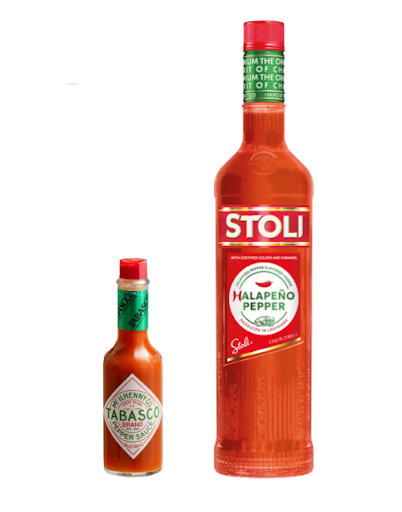
I’d like to say, you decide. But nope. The lawyers are involved.
Last week, McIlhenny Co., the company behind the ubiquitous Tabasco hot sauce, filed a lawsuit in Texas against Stoli Group (USA), LLC, asserting that Stoli’s spicy vodka, which hit shelves in December, infringes on Tabasco’s trade dress and that Stoli is engaged in unfair competition.
So what’s likely to happen? What are the merits of the parties’ respective positions? What the heck is trade dress, and is it what I wear to a formal affair? (OK, maybe not that.)
Before we get to these burning questions, let’s ask another: Why did Stoli pull this obvious copycat move? Well, there’s history. In 2024, Stoli and McIlhenny had initial discussions “about the potential development of co-branded pepper sauce vodka” that would be marketed under both the Tabasco and Stoli trademarks. However, McIlhenny “ultimately decided to go in a different direction and terminated discussions.” That different direction turned out to be a partnership with one of Stoli’s most famous competitors: Absolut Tabasco, which just launched. Zing!
Undaunted by McIlhenny’s rejection, Stoli continued development on its own, and in December, debuted its own peppery vodka product in the bottle pictured above that bears an unsubtle similarity to the Tabasco container — a design that, according to McIlhenny, is quite similar to what Stoli proposed to them for their potential co-branded product:
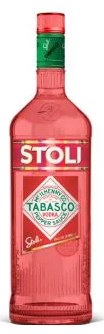
Trade dress is the official phrase that covers the shape and design of a product’s packaging. Think of the clear glass bottle with ridges and a red cap for Coca-Cola, or the squareish shape of a bottle of Maker’s Mark with its red wax seal on top. Here, it’s quite obvious that McIlhenny has trade dress rights, including, at a minimum, the green and red color scheme of Tabasco’s cap and labels. In fact, as it points out in its complaint, the company has at least four trademark registrations for Tabasco’s trade dress.
Case closed, right? Ah, but there’s a hitch. McIlhenny’s registrations, in the language of the United States Patent and Trademark Office are for “[c]ondiment-namely, pepper sauce,” “clothing, namely [t]-shirts and ties,” and (somewhat inexplicably), “pre-recorded audio and video compact disks featuring music, recipes and antique labels for educational, amusement, cultural and artistic purposes; computer mouse pads; neon signs and decorative magnets.”
Based on what’s in the complaint, McIlhenny does NOT have a registration covering beverages, alcoholic or otherwise. (As much as it would be fun on a slow day, I have not done a deep dive into McIlhenny’s full trademark portfolio, although I’m quite sure they don’t have any rights over Mexico’s Tabasco state.) The lack of beverage registration could make it hard for McIlhenny to pursue its claim for trade dress infringement. That doesn’t mean that they’re without rights here.
Clearly, regardless of whether the packaging is for “computer mouse pads; neon signs and decorative magnets” or for alcoholic beverages, the packaging for Tabasco is quite recognizable. So even if McIlhenny’s claim for trade dress infringement doesn’t go anywhere, its claim of unfair competition may fare better.
What’s likely to happen here? McIlhenny is requesting a preliminary injunction preventing Stoli from using the bottle until the lawsuit heads to trial. Ultimately, though, I predict the case will settle. For one thing, in 2024 Stoli Group (USA) filed for bankruptcy, and last month filed to convert proceedings to Chapter 7 liquidation (before one condemns Stoli as a purely evil villain here, keep in mind a lot of the company’s problems stem from its ongoing conflict with the Russian government over, among other things, Stoli’s public condemnation of the invasion of Ukraine). While I have no clue as to Stoli’s financial situation, as a general matter, being in bankruptcy means that the debtor owes more than it has coming in the door. Very rarely do plaintiffs want to spend the money associated with litigating to find out that there’s nothing left to satisfy an eventual judgment. McIlhenny’s goal then, is to get Stoli to stop copying their sauce, and not to try and squeeze some money out of them.
Stay tuned, updates to come as this one heats up.