Copyright
September 29, 2026
By Emily Poler
Most copyright disputes you hear about — and most that I write about — question whether a work has been infringed or whether an infringement constitutes fair use. But that’s not every case! There are pretty interesting and obscure provisions in the Copyright Act that sometimes come into play, like that at the crux of a current lawsuit brought by old-school hip-hop artists Salt-N-Pepa against the record label that owns the music from their golden age as the First Ladies of Rap.
This provision, section 203 of the Copyright Act, allows artists to reclaim their copyrights and/or sound recordings from an entity to whom they transferred ownership after 35 years. The thinking behind it is that throughout the history of pop music, artists often got screwed when they signed their first contracts because they had less bargaining power than they eventually gained after becoming successful (and having the wherewithal and cash to hire attorneys). Imagine the difference, say, in Dolly Parton’s ability to favorably negotiate her first record deal when she was an unknown teenager from eastern Tennessee versus the imperial powers the Queen of Country wielded at the time of her death (RIP Dolly 😢).
That said, this right of reclamation only exists where there was (a) a grant of a transfer or license of copyright, and (b) that grant was executed by the author. Notably, the statute specifically says this right to terminate a transfer or license does not apply to works for hire. This makes sense because when someone creates something as a work for hire, that person isn’t legally the author of the work; the company they work for is.
And all that is the problem for Salt-N-Pepa. In 1986, the group’s members, which include Cheryl James (Salt) and Sandra Denton (Pepa), entered into a couple of agreements with Noise in the Attic Productions, Inc. (NITA), a company owned by their producer and manager Hurby Azor. (As an aside, shout-out to the third member of the group, Deidra Roper a/k/a Spinderella, their DJ, who is not involved in the case. But we should never forget Spinderella.) That contract names NITA as the “sole and exclusive owner” of the master recordings and all copyrights. Azor subsequently assigned those rights to the Next Plateau Records label in an agreement that James and Denton were not signatories to (the pair only signed an attached “inducement letter”). The years went by, record labels were bought and sold, the industry consolidated and today, the rights to the four albums Salt-n-Pepa recorded between 1986 and 1993 are owned by entertainment behemoth Universal Music Group (UMG).
James and Denton now say that those agreements are subject to termination under the Copyright Act. In keeping with this, in 2022 they served UMG with notices of termination. UMG responded saying the 1986 agreements did not amount to a transfer of copyright based on how those original agreements were structured, and that Salt-N-Pepa’s recordings for NITA were also works for hire. Either way, says UMG, James and Denton weren’t eligible to get their copyrights back.
As will surprise no one who reads this blog, James and Denton filed suit. However, the District Court judge agreed with UMG and dismissed the case. In her dismissal, the judge wrote “the 1986 agreements do not indicate that Plaintiffs ever owned the copyrights to the sound recordings or that they granted a transfer of those rights to anyone else.” Basically, the judge determined that the only assignment of ownership was NITA’s transfer to Next Plateau and no contract James and Denton executed indicated otherwise. Crucially, the judge said that James and Denton had failed to expressly assert copyright ownership in their original agreement with NITA. Thus, according to the judge, James and Denton never held any copyrights in the work they created. While the judge didn’t issue a decision on whether the recordings were works for hire, she did note that the original copyright registrations described NITA as “employer for hire.”
Last week, the Second Circuit heard the appeal of this matter. Salt-n-Pepa’s attorneys argued that the 1986 agreements they signed with their producer transferred rights that are subject to the Copyright Act’s termination section. They also argued that the District Court judge erred by insisting that artists expressly assert copyright ownership in their contracts. According to Salt-n-Pepa’s attorneys, by doing so the judge invented a “new requirement out of whole cloth” where the Copyright Act has no such rule.
UMG, for its part, said that the 1986 agreements were clear that Salt-n-Pepa hadn’t granted or licensed their copyrights to their producer. Therefore, according to Universal, there was no agreement to be terminated under Section 203 of the Copyright Act.
As with all things litigation, we’ll have to wait and see where the Second Circuit comes out. If I had to guess, I’d say that there’s a chance the Second Circuit reverses the District Court’s opinion, but not because the District Court’s conclusion was necessarily wrong. Rather, I think the Second Circuit may find that the 1986 contracts are a bit of a mess and, therefore, the case shouldn’t have been dismissed at a very preliminary stage.
While this gets sorted, we can all kick back and bop down memory lane to Salt-N-Pepa classics like Push It, Shoop, Whatta Man, or Let’s Talk About Sex, right? NOPE! UMG has removed the old albums from streaming platforms, claiming the question of who could license the music was unresolved; James and Denton allege the action is retaliation against their efforts to reclaim their work. So if you want to hear the original hits, you’ll have to dig out your old CDs. Assuming you still have something to play them on; if not, ask your kid, because apparently CD players are back in vogue among Gens Z and A.
August 10, 2026
By Emily Poler
These two images of Miles Davis look pretty similar, eh?
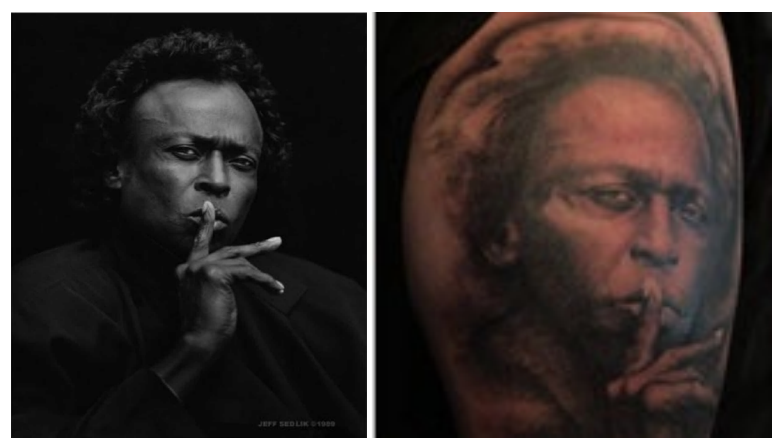
The question is, does the one on the right — a tattoo inked by reality TV star Katherine von Drachenberg (a/k/a Kat Von D) — infringe on the original, copyrighted photo taken by Jeff Sedlik in 1989?
According to the 9th Circuit, which affirmed a jury’s finding earlier this year, the answer is no. But that’s where things get interesting (at least for copyright nerds like us). Two of the three judges who affirmed the jury’s decision wrote separate, concurring opinions saying, in essence, that based on existing law we have to affirm the jury’s finding of no infringement — but we think that existing law is kinda f’d.
Before I explain their thinking, a little background. When Sedlik took the photo of the famed jazz trumpeter, he made all sorts of creative decisions regarding wardrobe and pose, going so far as to position Davis’ fingers to represent musical notes. He registered the photograph with the U.S. Copyright Office in 1994 and has since sold licenses authorizing limited reproduction, distribution, display, and creation of derivative works; he even once licensed the image for a tattoo. Just not the one pictured above.
In 2021, after Kat Von D inked that on a subject (purportedly tracing the photograph to create a stencil) and then posted pics on social media, Sedlik sued her. And yet, despite what to you and me might seem very obvious similarities between the photo and the tattoo, a jury concluded the tattoo did not constitute copyright infringement. Sedlik appealed, and a panel of three judges declined to overturn the jury’s decision.
That said, two of those judges took issue with the process by which the jury reached their decision. What’s their beef? Taking a step back, to establish infringement, the plaintiff has to show that the defendant unlawfully appropriated the copyrighted work. This requires showing that the two works are “substantially similar.” In the 9th Circuit — which includes California and, naturally, hears more than its share of copyright cases — this is examined through a two-part test. The first part of this test, which is called the extrinsic test and is decided by a judge, is supposed to assess the objective similarities of the two works with a particular focus on only those parts of the copyrighted work that are protectable. (It’s not always easy to separate what’s protectable from what’s not, since copyright protects original expression, and not the underlying concept. Lots of gray area there).
The second part — the intrinsic test — looks “for similarity of expression from the standpoint of the ordinary reasonable observer, with no expert assistance.” This part is, generally, up to a jury.
Copyright infringement requires both of these tests to be satisfied.
In the Kat Von D case, the two judges with the aggressive opinions took issue with the intrinsic test, with one of them writing it is “fundamentally flawed” and “virtually devoid of analysis.” Each judge wrote that the court should consider doing away with it because, in their view, it hands a complicated and ambiguous analysis to a jury with zero guidance. They find this problematic because it leaves decisions up to a jury’s “feel,” which in this case resulted in the jurors seeming to have ignored Sedlik’s protectable expression in his composition of the subject, which Von D clearly copied, instead deciding, “well, one’s a photo and one’s a tattoo so they’re not similar.” This intrinsic test, according to the two judges, does nothing to help jurors distinguish between the protected portions of a work and the unprotected portions and is at odds with Supreme Court precedent that suggests “to accord with the Copyright Act, a court should focus on carefully filtering out [unprotectable] concepts and ideas.”
What’s more, the judges are concerned that appeals courts don’t generally go around second-guessing juries on these types of decisions — which, in effect, gives juries in these cases a ton of power they maybe shouldn’t have. The judges also took issue with the fact that the nature of this test makes it nearly impossible for a plaintiff to win without going to trial, which places a heavy financial burden on anyone who feels they’ve been infringed upon.
Provocative stuff indeed (again, for copyright nerds). So what do I think? Well, the judges definitely make some good points. Infringement analysis can be very difficult for the average citizens on a jury who have no knowledge of the fine points of creative expression. The problem is, they don’t offer up any ideas for what they would put into place instead of the current test. They seem to be suggesting that such determinations would be better decided by judges and/or with the help of expert witnesses. Now, I’m not sure that judges are necessarily any more able than your average juror to determine what is or isn’t protectable, or that having judges make these decisions is going to lead to more predictable and consistent results.
This case is now going to be heard by all of the judges on the 9th Circuit. Maybe they’ll give us some guidance, which would be nice since, ultimately, this case is about how we figure out what is protected by copyright law and who determines this. Which is pretty important.
May 26, 2026
By Emily Poler
In an era where a lot of people have a problem taking responsibility — or, as is more weirdly said nowadays, “accountability” — for their actions and mistakes, institutions and large corporations are no different. Witness Samsung’s shrug of a response to a complaint filed against it earlier this month by pop star Dua Lipa, which essentially boils down to “someone told us what we were doing was OK.”
It’s a pretty simple suit. The Seoul-based electronics manufacturer and its US subsidiary has been selling televisions in boxes adorned with this image of the English entertainer:
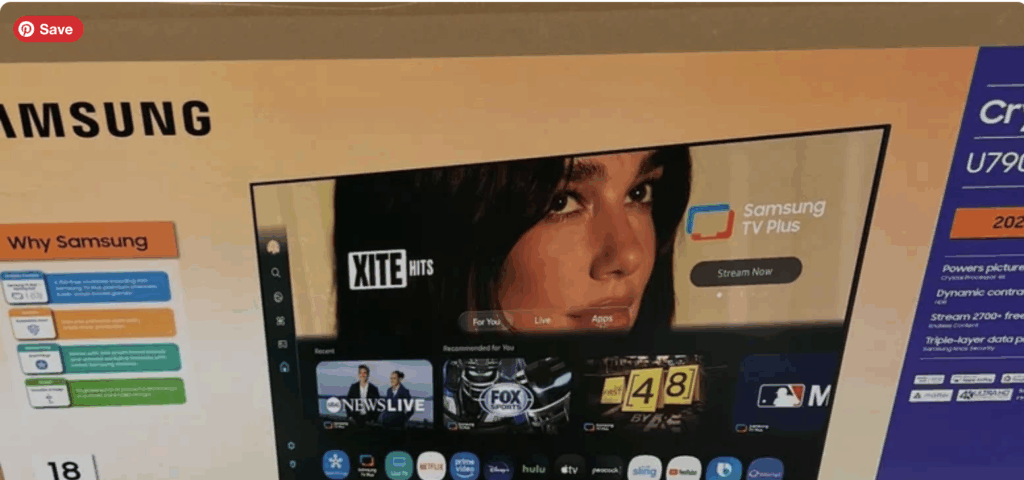
According to Ms. Lipa’s complaint, filed in California this month, the photo was taken backstage at the 2024 Austin City Limits Festival and shared in this post on her official Instagram account. The complaint further says that Dua Lipa has a registered copyright in the image, and thus asserts copyright and trademark infringement claims against Samsung, along with violation of Dua Lipa’s right of publicity.
The copyright claims are based on Samsung’s use of a copyrighted image without permission. The trademark claims are based on assertions that, by using her image to market televisions, Samsung is implying that she is endorsing its products. The right of publicity claims are based on Samsung’s use of her extremely valuable image in a commercial setting without permission.
Does this really matter? Well, according to Lipa’s team, shortly after the box appeared her fans began calling it the “Dua Lipa TV Box” on their socials, and the lawsuit cites specific Instagram comments like one user saying they would “get that TV just because Dua is on it,” and “if you need anything selling just put a picture of Dua Lipa on it.”
So yeah, it matters. Naturally, as with any modern celebrity, Ms. Lipa has legitimate sponsorship agreements with brands like Puma, Versace, and Yves Saint Laurent. She does not work with Samsung, and it seems obvious that someone in Dua Lipa’s organization would be aware of whether she gave anyone permission to use her photo on their product packaging.
The complaint goes on to say that Dua Lipa’s lawyers approached Samsung about trying to resolve this matter and Samsung refused, ignoring “repeated demands” to “cease and desist from infringing on her rights.” In other words, shrug, because hey, sue me.
Samsung did eventually issue a statement, saying the photo was “originally provided by a content partner for our free streaming service Samsung TV Plus. The image was used only after receiving explicit assurance from the content partner that permission had been secured, including for the retail boxes. Given this assurance, we deny any allegations of intentional misuse.” So far Samsung has not named that third-party “content partner.”
In my view this is not a great defense. Notably, Samsung doesn’t say “oh, hey, we have this written agreement that lets us use this image.” Nor does it say, “once we found out there was an issue we immediately took steps to correct this problem.” Rather, this sounds an awful lot like a teenager saying, “gosh, my friend’s parents told me I could!” when caught doing something they weren’t supposed to do. (Also, I have a teenager at home, so maybe I’m just seeing everything in terms of how a modern kid might see the world.)
Samsung’s statement goes on: “We have actively sought and remain open to a constructive resolution with Ms. Lipa’s team.” Here’s a suggestion for a constructive resolution: take the darn picture off the boxes when asked instead of (allegedly) ignoring her requests to do so and then claiming you have been assured you have the rights to use the image. Seems simple, no?
All that said, Samsung hasn’t formally answered the complaint yet, so it will be interesting to see what it says when they do. Unless it can explain exactly how it has rights to use the photo at issue, I don’t see this getting a whole lot better for the company, especially because at least some of Dua Lipa’s claims allow her to shift her attorneys’ fees onto Samsung if she prevails, on top of the $15 million her suit is seeking.
But hey, I guess a multinational giant like Samsung can just shrug that off, too.
April 29, 2026
By Emily Poler
About a month ago, the Supreme Court in Cox Communications, Inc. v. Sony Music Entertainment reversed a $1 billion verdict against Cox, an Internet service provider. That verdict stemmed from Cox’s failure to prevent subscribers from infringing Sony’s copyrighted works by sharing pirated copies over Cox’s network. The Supreme Court held that a service provider can only be liable for what is called “contributory infringement” by a third-party (in this case, a user) if the service either induced the infringement or sold a service specifically tailored for infringement. In its decision, the Court held Cox was not liable for contributory infringement because it failed to do anything to affirmatively prevent it. Put another way, Cox’s inaction was not enough to incur liability.
One AI company quickly jumped on this decision to argue that it shouldn’t be liable for what users do with its own platform. In Disney Enterprises, Inc. et al v. MiniMax et al, Disney and other large studios are suing China-based MiniMax and its Singaporean owner Nanonoble Pte. Ltd., which offers an app called Hailuo AI. This app allows users to create short videos in response to prompts and is marketed with the tagline, “A Hollywood studio in your pocket.” In theory, this is cool, except that what Hailuo also does is let users make little videos starring Star Wars and Marvel characters, among other well-known properties.
Since Hailuo is AI, naturally the Plaintiffs claim it was created using unauthorized copies of the studios’ works. And, of course, Plaintiffs say any user output that publicly reproduces Darth Vader, Spiderman et al. are unauthorized copies or derivative works of the studios’ copyrighted properties.
MiniMax makes a bunch of arguments as to why the complaint should be dismissed, some of which have enough teeth to maybe lead to dismissal or partial dismissal. For example, MiniMax argues that much of its conduct took place outside of the United States and, therefore, cannot serve as the basis for a claim under U.S. copyright law. In fact, the Plaintiffs spent months after their initial filing unsuccessfully attempting to serve the Defendants in Singapore and China, and the federal judge in the case had threatened to toss the lawsuit in December as a result of these issues.
Other of the Defendants’ arguments are more, shall we say, creative. MiniMax asserts that while the studios complain that Hailuo’s outputs depict characters from their movies and TV shows, the studios can’t point to specific copyright registrations covering those characters. That argument is a bit much because it seems impossible to obtain an image of, say, the Mandalorian or Iron Man, without reproducing a portion of the copyrighted work they appear in. It seems equally hard to claim that a user can make a Shrek short without intruding on the copyright owners’ rights to make derivative works based on their copyrighted materials.
In the wake of the Supreme Court’s Cox decision, MiniMax also argues it shouldn’t be held liable merely because it didn’t prevent Hailuo from outputting infringing content, despite having that ability. (The company did put guardrails in place to prevent Hailuo from creating pornographic or violent content.) According to MiniMax, the failure to include these guardrails is, at most, inaction and not an affirmative act, and within the framework of Cox there’s no contributory liability for mere inaction. However, the line between inaction and action is pretty blurry here. Creating and marketing a platform that is appealing because it lets users make fan films of their favorite characters seems pretty active to me.
On top of that, MiniMax is claiming it’s not responsible for user infringement because it didn’t actively encourage that infringement. Really? Hailuo’s tagline of “A Hollywood studio in your pocket” sounds pretty encouraging to me. MiniMax says the slogan describes “the quality and creative capability” of Hailuo,” but I think it could be interpreted as urging users to create works based on those of Hollywood studios. My view is buttressed by the claim, according to the complaint, that MiniMax allegedly used Spiderman in Hailuo’s marketing materials. This type of question — a fact question — is going to make it hard for the judge to dismiss the complaint.
And that means that despite miniMax’s assertions, there should be plenty of action ahead in this case.
April 14, 2026
By Emily Poler
I do not play mahjong. I do, however, have a whole bunch of friends who are very into the game. I sit with them and knit while they play — it’s a low-key, social way to spend a weekend afternoon.
Now, you might be wondering: what is mahjong? Well, mahjong (or mah jongg or mahjongg; they’re all correct) originated in China in the 19th century and is similar to a card game but played with tiles that look a little bit like dominoes. Players draw these tiles and, relying on skill, strategy and luck, try to arrange them into particular combinations to win. In the United States, those combinations are determined each year by the National Mah Jongg League, which publishes an annual card listing the winning hands.
By now, I bet you’re thinking there’s literally no way she’s going to be able to connect this to IP law or litigation. Wrong!
The first time I ever sat to the side of my friends’ mahjong game, I picked up one of the cards sold by the National Mah Jongg League card and was rather surprised to see this:

I was, of course, immediately curious and went to the Copyright Office’s website to look up whether the National Mah Jongg League does, in fact, have a copyright for the card. Yes, it does, and has for many years. And if you’re going to (legitimately) play mahjong in the US, you need to buy that card every year from the League.
Seems weird, right? After all, if you buy Monopoly or a deck of cards, you’re done spending on it. The rules of Monopoly or poker don’t change every year. It doesn’t matter if it’s 1996, 2016 or 2066: a flush always beats two pairs. Most of all, the rules of a game can’t be copyrighted; nobody owns the rules for chess, checkers, or blackjack. However, a book or pamphlet that describes how to play any of those games is absolutely copyrightable. Such is the case with the yearly mahjong card, which expresses the rules for playing mahjong by listing the winning combinations the League has established for that year.
For what it’s worth, I haven’t seen anything suggesting that the National Mah Jongg League has sued anyone who copies a card from a friend, although, if I had to guess, I bet they send plenty of cease-and-desist letters to people offering copycat cards on Amazon or Etsy. (Maybe not, because, according to Reddit, the group isn’t exactly super tech savvy, and their website is pretty 2003.)
Again, I’m an observer, not a player, but one of the fascinating things to me is that players seem really conscientious about actually buying the cards each year. The mahjong group text I’m on was recently awash with people touting they had acquired the 2026 card, even though any of them could just buy one and pass around copies.
In a world awash in so much digital piracy, I find this astoundingly honorable. That said, I suppose it’s not that surprising: for one thing, the card is an awkward shape and folds into several pages, and it would be a pain to copy it or play off a copy. Also, at $15, it’s not terribly expensive. Most of all, I imagine that for those who love the game, buying the card each year is something of a ritual, and it just wouldn’t feel right to use a copy on flimsy printer paper. All this seems like a pretty marked contrast from lots of today’s aggressively online culture, which prioritizes virtual sharing and remixing of non-physical media, and, unfortunately, not paying for stuff. Exhaustion with such probably explains why more and more people are shunning such soulless activity to get together in person and play a game with physical pieces and rules.
In any event, I’m looking forward to a spring and summer of sitting to the side, knitting needles in hand, listening to the murmur of my friends and the clicks of tiles being drawn and discarded.
