Copyright
February 19, 2025
As the lawyers reading this know, media giant Thomson Reuters has a proprietary online research database called Westlaw. In addition to hosting cases and statutes, Westlaw also includes original material written by Westlaw editors. A recent decision involving that original content and its use by Ross Intelligence, a potential Thomson Reuters competitor, to create an AI-powered product may provide a bit of a roadmap on fair use and other issues facing the courts considering cases against OpenAI, Perplexity and other generative AI platforms.
First, some background: while the bulk of Westlaw’s content — statutes, rules, ordinances, cases, administrative codes, etc.— are not subject to copyright protection, Westlaw editors concisely restate the important points of a case with short summaries. Each is called a Headnote. Westlaw organizes Headnotes into something called the West Key Number System, which makes it much easier to find what you’re looking for.
This case began when Ross asked to license Westlaw’s Headnotes to create its own, AI-powered legal research search engine. Not surprisingly, Thomson Reuters didn’t want to help create a competitor and said no.
As a workaround, Ross hired a company called LegalEase, which in turn hired a bunch of lawyers to create training data for Ross’ AI. This training data took the form of a list of questions, each with correct and incorrect answers. While the lawyers answering these questions were told not to simply cut and paste Headnotes, the answers were formulated using Westlaw’s Headnotes and the West Key Number System. LegalEase called these “Bulk Memos.”
Thomson Reuters was none too happy about this and sued Ross for, among other things, copyright infringement, claiming that “Ross built its competing product from Bulk Memos, which in turn were built from Westlaw [H]eadnotes.” In its defense, Ross claimed that Westlaw’s Headnotes were not subject to copyright protection, and that to the extent it infringed on Thomson Reuters’ copyrights, its use constituted fair use.
In 2023 the Court largely denied Thomson Reuters’ motion for summary judgment, ruling that, among other things, the question of whether Headnotes qualify for copyright protection would have to be decided by a jury. The Court, however, subsequently had a change of heart and asked Thomson Reuters and Ross to renew their motions for summary judgment. Earlier this month, the Court ruled on these renewed motions.
Of note, the Court found that at least some Headnotes qualified for copyright protection, as did the West Key Number System. On the Headnotes, the Court found that the effort of “distilling, synthesizing, or explaining” a judicial opinion was sufficiently original to qualify for copyright protection. The Court also found the West Key Number System to be sufficiently original to clear the “minimal threshold for originality” required for copyright protection. The Court further found that the Bulk Memos infringed on some of the Headnotes.
The Court also rejected Ross’ assertion of fair use. Its decision was based largely on the fact that Ross was using Thomson Reuters’ Headnotes to create a competing product. Here, the Court looked at not only Thomson Reuters’ current market, but also potential markets it might develop, finding that since Thomson Reuters might create its own AI products the Ross product could negatively impact the market for Thomson Reuters, which weighed against fair use.
The Court was not impressed with Ross’ reliance on a line of cases finding copying of computer code at an intermediate step to be fair use. Here, the Court noted that Ross was not copying computer code. Moreover, in those cases, the copying was necessary to access purely functional elements of a computer program and achieve new, transformative purposes. In contrast, Ross used Headnotes to make it easier to develop a competitive product.
Ultimately, these conclusions are most interesting because of what other courts hearing AI infringement cases may take from them. Sure, there are differences (notably, Ross doesn’t seem to be using generative AI), but this case highlights some of the legal and factual issues we’re going to see as other cases move forward. In particular, I think the fact that the Court here found that the process of summarizing or distilling longer cases into Headnotes renders the Headnotes subject to copyright protection may be problematic for companies such as OpenAI, which has tried to claim that it is only ingesting underlying facts from news articles. If creating Headnotes is sufficiently original to qualify for copyright protection, then it seems likely that a reporter selecting the facts to include in a news article is also sufficiently original.
Stay tuned. There is much, much more to come.
December 17, 2024
Of the many lawsuits media giants have filed against AI companies for copyright infringement, the one filed by Dow Jones & Co. (publisher of the Wall Street Journal) and NYP Holdings Inc. (publisher of the New York Post) against Perplexity AI adds a new wrinkle.
Perplexity is a natural-language search engine that generates answers to user questions by scraping information from sources across the web, synthesizing the data and presenting it in an easily-digestible chatbot interface. Its makers call it an “answer engine” because it’s meant to function like a mix of Wikipedia and ChatGPT. The plaintiffs, however, call it a thief that is violating Internet norms to take their content without compensation.
To me, this represents a particularly stark example of the problems with how AI platforms are operating vis-a-vis copyrighted materials, and one well worth analyzing.
According to its website, Perplexity pulls information “from the Internet the moment you ask a question, so information is always up-to-date.” Its AI seems to work by combining a large language model (LLM) with retrieval-augmented generation (RAG — oh, the acronyms!). As this is a blog about the law, not computer science, I won’t get too deep into this but Perplexity uses AI to improve a user’s question and then searches the web for up-to-date info, which it synthesizes into a seemingly clear, concise and authoritative answer. Perplexity’s business model appears to be that people will gather information through Perplexity (paying for upgraded “Pro” access) instead of doing a traditional web search that returns links the user then follows to the primary sources of the information (which is one way those media sources generate subscriptions and ad views).
Part of this requires Perplexity to scrape the websites of news outlets and other sources. Web scraping is an automated method to quickly extract large amounts of data from websites, using bots to find requested information by analyzing the HTML content of web pages, locating and extracting the desired data and then aggregating it into a structured format (like a spreadsheet or database) specified by the user. The data acquired this way can then be repurposed as the party doing the gathering sees fit. Is this copyright infringement? Probably, because copyright infringement is when you copy copyrighted material without permission.
To make matters worse, at least according to Dow Jones and NYP Holdings, Perplexity seems to have ignored the Robots Exclusion Protocol. This is a tool that, among other things, instructs scraping bots not to copy copyrighted materials. However, despite the fact that these media outlets deploy this protocol, Perplexity spits out verbatim copies of some of the Plaintiff’s articles and other materials.
Of course, Perplexity has a defense, of sorts. Its CEO accuses the Plaintiffs and other media companies of being incredibly short sighted, and wishing for a world in which AI didn’t exist. Perplexity says that media companies should work with, not against, AI companies to develop shared platforms. It’s not entirely clear what financial incentives Perplexity has or will offer to these and other content creators.
Moreover, it seems like Perplexity is the one that is incredibly shortsighted. The whole premise of copyright law is that if people are economically rewarded they will create new, useful and insightful (or at least, entertaining) materials. If Perplexity had its way, these creators would not be paid at all or accept whatever it is that Perplexity deigns to offer. Presumably, this would not end well for the content creators and there would be no more reliable, up-to-date information to scrape. Moreover, Perplexity’s self-righteous claim that media companies just want to go back to the Stone Age (i.e., the 20th century) seems premised on a desire for a world in which the law allows anyone who wants copyrighted material to just take it without paying for it. And that’s not how the world works — at least for now.
September 9, 2024
Last week, the U.S. Court of Appeals for the Second Circuit affirmed a federal judge’s March 2023 holding that the Internet Archive’s practice of digitizing library books and making them freely available to readers on a strict one-to-one ratio was not fair use. For reasons I’ll get into below, the outcome is pretty unsurprising. It’s also worth looking at because it likely previews some of the arguments we’ll hear in the case between the New York Times and OpenAI (creators of ChatGPT) and Microsoft if (or when) that case makes it to the Second Circuit. (Quick summary of my post on the subject: The New York Times Company filed suit late in December against Microsoft and several OpenAI affiliates, alleging that by using New York Times content to train its algorithms, the defendants infringed on the media giant’s copyrights, among other things.)
First, some background. The Internet Archive is a not-for-profit organization “building a digital library of Internet sites and other cultural artifacts in digital form” whose “mission is to provide Universal Access to All Knowledge.” To achieve this rather lofty goal, the Archive created its Open Library by scanning printed books in its possession or in the possession of a partner library and lending out one digital copy of a physical book at a time, in a system it dubs Controlled Digital Lending.
Enter COVID-19. During the height of the pandemic, when everyone was stuck at home without much to do, the Archive launched the National Emergency Library. This did away with Controlled Digital Lending and allowed almost unlimited access to each digitized book in its collection.
Not surprisingly, book publishers, who sell electronic copies of books to both individuals and libraries, were not thrilled. Four big-time publishers — Hachette, Penguin Random House, Wiley, and HarperCollins — sued the Internet Archive for copyright infringement, targeting both its National Emergency Library and Open Library as “willful digital piracy on an industrial scale.”
The Internet Archive responded that these projects constituted fair use and, therefore, did not infringe on the publisher’s copyrights. To back this up, the Archive claimed it was using technology “to make lending more convenient and efficient” because its work allowed users to do things that were not possible with physical books, such as permitting “authors writing online articles [to] link directly to” a digital book in the Archive’s library. The Archive also insisted its library was not supplanting the market for the publisher’s products.
The District Court rejected these arguments, holding that no case or legal principle supported the Archive’s defense that “lawfully acquiring a copyrighted print book entitles the recipient to make an unauthorized copy and distribute it in place of the print book, so long as it does not simultaneously lend the print book.” The judge also deemed the concept of Controlled Digital Lending “an invented paradigm that is well outside of copyright law.”
In affirming the District Court’s ruling, the Second Circuit Court applied the four-part test for fair use that looks at: (1) the purpose and character of the use; (2) the nature of the copyright work; (3) the portion of the copyrighted work used (as compared to the entirety of the copyrighted work); and (4) the impact of the allegedly fair use on the potential market for or value of the copyrighted work.
The first factor — the purpose and character of the use — is broken down into two subsidiary questions: Does the new work transform the original, and is it of a commercial nature or is it for educational purposes? Neither the District Court nor the Court of Appeals bought the Internet Archive’s claim that its Open Library was transformative. The Court of Appeals held that the digital books provided by the Internet Archive “serve the same exact purpose as the original; making the authors’ works available to read.” (The Court of Appeals did find that, as a not-for-profit entity, the Internet Archive’s use of the books was not commercial.)
On the second factor, which is generally unimportant here, the Court of Appeals also found in favor of the publishers. Of greater significance is factor three, which looks at how much of the copyrighted work is at issue. Copying a sentence or a paragraph of a book length work is more likely to be fair use than copying the entire book which, of course, is exactly what the Internet Archive was doing. Again, another win for the publishers.
And arguments on factor four — the impact on the market for the publishers’ products — didn’t work out any better for the Internet Archive. Notably, the Court of Appeals found that the Internet Archive was copying the publishers’ books for the exact same purpose as the original works offered by the publisher, thus naturally impacting their market and value.
So what are the takeaways here as we look ahead to the case between the New York Times and Open AI/Microsoft?
On the one hand, OpenAI/Microsoft have copied entire articles from the Times (and the numerous other plaintiffs that are suing OpenAI and Microsoft), which will hurt OpenAI/Microsoft claims of fair use. Likewise, OpenAI/Microsoft’s fair use arguments won’t get very far if the Times can show that ChatGPT’s works are negatively impacting the market for its work or functioning as a substitute for journalism.
On the other hand, if OpenAI/Microsoft can show that ChatGPT’s output transformed the Times’ content, it may be able to prevail on fair use.
In any event, the case between OpenAI and Microsoft and The New York Times is likely to include a lot more ambiguity than in the Internet Archive matter, with the potential to result in new interpretations of copyright law with massive consequences for media and technology companies worldwide.
August 6, 2024
Everything should be clicking (as it were) for TikTok influencer Sydney Nicole Gifford. She has half a million followers who eat up her posts promoting home and fashion items from Amazon, propelling her to the kind of celebrity that garnered coverage in People for her pregnancy. But alas, Gifford is apparently a little too influential.
She claims fellow TikToker Alyssa Sheil is copying her posts and using Gifford’s visual style to promote the same products! And yes, Gifford is now suing Sheil, in a case that could shake up the world of social media influencers and potentially make it harder for influencers to create content without fear of accusations of copying.
According to the complaint, which was filed in District Court in Texas, Gifford “spends upwards of ten hours a day, seven days a week, researching unique products and services that may fit her brand identity, testing and assessing those products and services, styling photos and videos promoting such products and editing posts…” for social media. As a result, according to the complaint, “Sydney has become well-known for promoting certain goods from Amazon, including household goods, apparel, and accessories, through original photo and video works…”
The lawsuit goes on to allege that defendant Sheil “replicated the neutral, beige, and cream aesthetic of [Gifford’s] brand identity, featured the same or substantially [the same] Amazon products promoted by [Gifford], and contained styling and textual captions replicating those of [Gifford’s] posts.” It says at least 40 of Sheil’s posts feature “identical styling, tone, camera angle and/or text,” to Sydney’s. Here’s a pretty obvious one, with Gifford on the left and Sheil on the right.
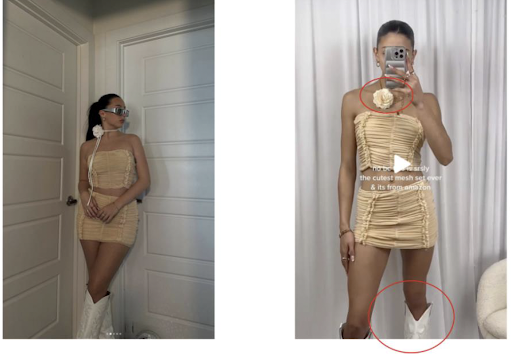
In the suit, Gifford is claiming, among other things, trade dress infringement, violation of the Digital Millennium Copyright Act, copyright infringement (she has registered copyrights for some of her posts and videos), and unfair competition.
Does Gifford have a case? Here’s what I think:
- To prevail on the claim for infringement of her trade dress Gifford will have to establish, at a minimum, that consumers associate her “aesthetic” with her. That may be difficult because, at least to my eye, the style of Gifford’s posts doesn’t seem wildly different from a lot of other influencers. (I am so not her target audience and I’m doing my best not to dunk on her “aesthetic,” but I have to put “aesthetic” in quotes to convey my eyeroll.)
- The claim under the Digital Millennium Copyright Act is based on the fact that Sheil removed Gifford’s name or social media handle from posts. This is, shall we say, a novel argument given that the intent of the DMCA is to prevent people from circumventing digital rights management software. This is not that. At all.
- The copyright claim is going to raise a lot of questions about exactly how original these social media posts are and, as a result, how much protection under copyright law they are entitled to. Gifford and other social media influencers might find out that they don’t like the answer to this question.
- If Gifford is able to establish that consumers associate her “aesthetic” with her, she could win the battle… but lose the war because it might open her up to lawsuits by other influencers who claim that she copied their look.
Meanwhile, Sheil has asked the Court to dismiss Gifford’s case.
Thinking more broadly, a decision or decisions on the copyright claim could have implications for appropriation artists and others who closely copy another creator’s work. Which is one reason it will be fascinating to see how this plays out. And yes, I know I often end these posts saying something like that. Because it’s true! This case, as with so many IP lawsuits lately, especially those that involve AI, are all going where no court has gone before (or even imagined possible ten years ago). Every one of these potential decisions could have massive socioeconomic impact, with a real effect on how a lot of people earn a living and how the rest of us spend a lot (probably too much) of our time.
May 29, 2024
If you’re into hip hop, you’re probably familiar with a photograph of rapper The Notorious B.I.G., a/k/a Biggie Smalls, looking contemplative behind designer shades with the Twin Towers of the World Trade Center in the distance behind him. However, you might not know this well-known portrait has been the subject of litigation for the past five years and that litigation settled just before a trial was supposed to start earlier this year.
Photographer Chi Modu snapped the picture (the “Photo”) in 1996, originally for the cover of The Source hip hop monthly. However, after the magazine used another image, and Biggie was killed a year later, Modu began licensing the image to various companies, including Biggie’s heirs’ own marketing company. The Photo became famous and, after the destruction of the World Trade Center in 2001, what is now commonly called “iconic.”
There was no beef (do people still say that?) between Modu and Biggie’s heirs until 2018 when, according to an attorney for Chi Modu’s widow (the photographer himself passed away in 2021), Modu tried to negotiate increased licensing fees with Notorious B.I.G. LLC (“BIG”), which owns and controls the intellectual property rights of the late rapper’s estate.
Apparently, Modu and BIG weren’t able to reach an agreement because BIG brought suit against Modu and a maker of snowboards bearing the image, asserting claims for federal unfair competition and false advertising, trademark infringement, violation of state unfair competition law and violation of the right of publicity.
In a countersuit, Modu asserted his copyright in the Photo of Biggie preempted all of BIG’s claims. Modu argued that BIG’s claims were nothing more than an attempt to interfere with his right to reproduce and distribute the Photo, as permitted under Section 301 of the Copyright Act.
In December 2021, BIG sought a preliminary injunction barring Modu from selling merchandise including skateboards, shower curtains and NFTs incorporating the Photo, claiming these uses violated its exclusive control of Biggie’s right of publicity. (BIG had previously settled with the snowboard manufacturer.)
In June 2022, the Court granted the injunction in part, concluding that the sale of skateboards and shower curtains was not preempted by the Copyright Act as they did not involve the sale of the Photo itself but rather items featuring the Photo. In its order, it prohibited Modu’s estate from selling merchandise featuring the Photo or licensing the Photo for such use. However, the Court permitted Modu’s estate to continue selling reproductions of Modu’s photo as “posters, prints and Non-Fungible Tokens (‘NFTs’).” The Court found that the posters, prints and NFTs were “within the subject matter of the Copyright Act [as t]hey relate to the display and distribution of the copyrighted works themselves, without a connection to other merchandise or advertising.”
This decision follows a line of cases that distinguish between the exploitation of a copyright and the sale of products “offered for sale as more than simply a reproduction of the image.” In the former situation, a copyrighted work will take precedence over a right of publicity claim. In the latter, where the products feature something more than just the copyrighted work, a right of publicity claim is likely to prevail.
Not surprisingly, given the risks for both sides, the case settled just prior to the start of the trial. Although the contours of the settlement were not made public, presumably it allowed Modu’s estate to continue selling the Photo as posters of it remain available for purchase on the photographer’s website.
