
August 10, 2026
When is a Copy Not a Copy? When a Jury Says So
By Emily Poler
These two images of Miles Davis look pretty similar, eh?
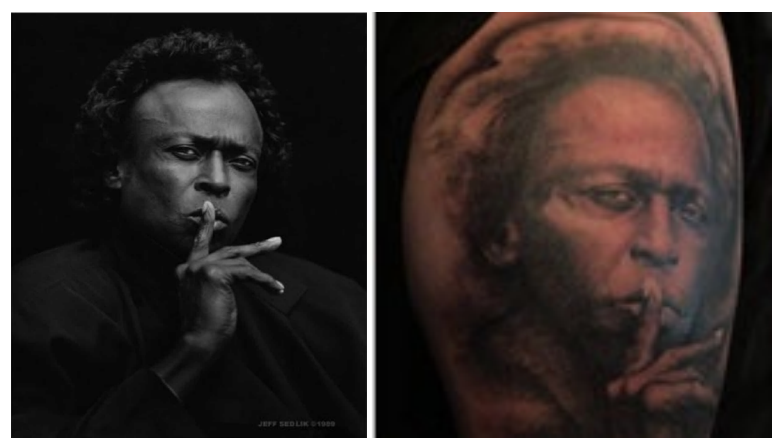
The question is, does the one on the right — a tattoo inked by reality TV star Katherine von Drachenberg (a/k/a Kat Von D) — infringe on the original, copyrighted photo taken by Jeff Sedlik in 1989?
According to the 9th Circuit, which affirmed a jury’s finding earlier this year, the answer is no. But that’s where things get interesting (at least for copyright nerds like us). Two of the three judges who affirmed the jury’s decision wrote separate, concurring opinions saying, in essence, that based on existing law we have to affirm the jury’s finding of no infringement — but we think that existing law is kinda f’d.
Before I explain their thinking, a little background. When Sedlik took the photo of the famed jazz trumpeter, he made all sorts of creative decisions regarding wardrobe and pose, going so far as to position Davis’ fingers to represent musical notes. He registered the photograph with the U.S. Copyright Office in 1994 and has since sold licenses authorizing limited reproduction, distribution, display, and creation of derivative works; he even once licensed the image for a tattoo. Just not the one pictured above.
In 2021, after Kat Von D inked that on a subject (purportedly tracing the photograph to create a stencil) and then posted pics on social media, Sedlik sued her. And yet, despite what to you and me might seem very obvious similarities between the photo and the tattoo, a jury concluded the tattoo did not constitute copyright infringement. Sedlik appealed, and a panel of three judges declined to overturn the jury’s decision.
That said, two of those judges took issue with the process by which the jury reached their decision. What’s their beef? Taking a step back, to establish infringement, the plaintiff has to show that the defendant unlawfully appropriated the copyrighted work. This requires showing that the two works are “substantially similar.” In the 9th Circuit — which includes California and, naturally, hears more than its share of copyright cases — this is examined through a two-part test. The first part of this test, which is called the extrinsic test and is decided by a judge, is supposed to assess the objective similarities of the two works with a particular focus on only those parts of the copyrighted work that are protectable. (It’s not always easy to separate what’s protectable from what’s not, since copyright protects original expression, and not the underlying concept. Lots of gray area there).
The second part — the intrinsic test — looks “for similarity of expression from the standpoint of the ordinary reasonable observer, with no expert assistance.” This part is, generally, up to a jury.
Copyright infringement requires both of these tests to be satisfied.
In the Kat Von D case, the two judges with the aggressive opinions took issue with the intrinsic test, with one of them writing it is “fundamentally flawed” and “virtually devoid of analysis.” Each judge wrote that the court should consider doing away with it because, in their view, it hands a complicated and ambiguous analysis to a jury with zero guidance. They find this problematic because it leaves decisions up to a jury’s “feel,” which in this case resulted in the jurors seeming to have ignored Sedlik’s protectable expression in his composition of the subject, which Von D clearly copied, instead deciding, “well, one’s a photo and one’s a tattoo so they’re not similar.” This intrinsic test, according to the two judges, does nothing to help jurors distinguish between the protected portions of a work and the unprotected portions and is at odds with Supreme Court precedent that suggests “to accord with the Copyright Act, a court should focus on carefully filtering out [unprotectable] concepts and ideas.”
What’s more, the judges are concerned that appeals courts don’t generally go around second-guessing juries on these types of decisions — which, in effect, gives juries in these cases a ton of power they maybe shouldn’t have. The judges also took issue with the fact that the nature of this test makes it nearly impossible for a plaintiff to win without going to trial, which places a heavy financial burden on anyone who feels they’ve been infringed upon.
Provocative stuff indeed (again, for copyright nerds). So what do I think? Well, the judges definitely make some good points. Infringement analysis can be very difficult for the average citizens on a jury who have no knowledge of the fine points of creative expression. The problem is, they don’t offer up any ideas for what they would put into place instead of the current test. They seem to be suggesting that such determinations would be better decided by judges and/or with the help of expert witnesses. Now, I’m not sure that judges are necessarily any more able than your average juror to determine what is or isn’t protectable, or that having judges make these decisions is going to lead to more predictable and consistent results.
This case is now going to be heard by all of the judges on the 9th Circuit. Maybe they’ll give us some guidance, which would be nice since, ultimately, this case is about how we figure out what is protected by copyright law and who determines this. Which is pretty important.